• Great Lakes Marsh Monitoring Program released

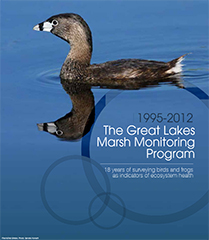
    The Great Lakes Marsh Monitoring Program
    Eighteen years in the making Bird Studies Canada releases The Great Lakes Marsh Monitoring Program.

    This 12 page report concludes that most marsh breeding birds are in decline. No real surprise with loss of wetland habitat and human population growth surrounding coastal marshes. The population of frogs remains stable except for chorus frog which shows decline. The program helped to increase the public’s awareness of the importance of wetland conservation.

    Two or our club members deserve special mention for being citizen scientists who volunteered their time to collect data. Diane and her mother Norma have been going to Corner’s Corners since 2006 to record their frog and bird sightings. They start in April with frogs and add the birds after May 20th. The survey runs till early July each year. They were able to see pied-billed grebe’s and hear Sora. They heard spring peepers, chorus frogs, American toads, bullfrogs and green frogs. The mosquitoes were never a issue at Pete’s place and their most memorable event was watching a raccoon try to squeeze its way out of a wood duck box. Thank you Diane for sharing this with us.

  • 294 species in 24 hours

    Big Day 2013
    Big Day 2013
    The people that took Anna’s birding course in April will remember seeing the Inside Birding series with Jessie Barry and Chris Wood. These two made up part of the Team Sapsucker as they sighted 294 species, 30 more than before in 24 hours. This record will probably stand for a while. They must all be suffering from warbler neck and sleep deprivation. Nice job folks.

  • St Thomas Field Naturalist Club Flickr site

    There is now a Flickr site for members to upload their pictures for all to see. It is www.flickr.com/groups/stfnaturalist/

    If you have a Flickr account just join group and upload pictures that relate to things of interest to the club. If you are not a member I can send you an invite to the group. Let me know.

  • Insecticide killing bees

    There is a good article in The Weekly News about neonicontinoids, a nicotine based insecticide killing the honey bees. We cannot afford to lose our honey bees; they are part of the complex web of life that sustains us. The manufacturer’s have known this for a long time. Wish there was an easy answer, but there isn’t. Of course we could let nature take care of the insects!

  • Baillie Birdathon sponsorship in full swing

    baillie_birdathon_2013

    The St Thomas Field Naturalist Club fundraising for Bird Studies Canada and our club through the Baillie Birdathon is on now. Martha is leading the fundraiser this year. You can pledge by contacting Martha at the meeting in May.

    To receive a income tax receipt please include your email address. Receipts will be issued via email to all those donating $10 or more. Sponsors with valid email addresses will also receive Bird Studies Canada’s free bi-weekly e-newsletter Latest News. All sponsors of $35 or more are considered a “Supporter of Bird Studies Canada” and will receive quarterly issues of their publication, Bird Watch Canada for one year.

    Thanks to all who have contributed in past years and look forward to your continued support.

    Here is a 4 minute clip from Cornell Lab when they got 264 species in 24 hours in 2012.
    We will not get anywhere near that but will sure have fun.

  • Thanks to Ted Suckley

    Ted has looked after the St Thomas Field Naturalist Club blog for many years. We are thankful for his assistance in transitioning to this new format. Ted’s original blog is still up and viewable at http://sttnaturalist.blogspot.ca

    Many thanks to Ted
    Al Sharpe